Motivation Link to heading
An AI provider does not merely sell an answer. By receiving the information needed to produce that answer, it may also learn how to produce better answers in the future.
That creates two economic flows in every context-rich AI relationship:
- Learning travels: private operating context enters an AI system and may improve what the system can do elsewhere.
- Value travels: some of the operating value created by the system returns to the AI provider through a price.
Neither flow is automatic. A clinic may be willing to use an outside diagnostic system but unwilling to let the provider learn from its patient outcomes. Or it may permit the learning while retaining most of the resulting savings because the provider cannot observe or verify them. Common ownership changes both flows: it can keep learning inside one organization, and it can turn an uncollectible service benefit into operating cash flow.
The models in this article ask what organization follows. Does the owner share all of its context, sell the right to learn from it, withhold part of it, or bring the capability inside the firm? If ownership wins, should one firm own one operating asset or many? Could an AI platform obtain the same learning by serving independent customers? And can that platform charge for enough of the value it creates to remain independent?
The combined answer is:
AI context is governed by two incomplete markets: one for future learning and one for the operating value that learning creates. Gaps in the first market can produce secrecy or ownership; gaps in the second can produce ownership even when learning travels perfectly. Whether that ownership grows into a large rollup then depends on cross-asset learning, shared costs, organizational burden, and the customer relationships cut by the new firm boundary.
Status: calibrated theoretical computation. The result is supported by analytical derivations and reproducible computations. The parameters in the figures are transparent normalizations, not estimates of present AI markets.
Vocabulary Link to heading
Imagine an AI intermediary serving several operating businesses: clinics, laboratories, insurers, warehouses, or factories. Each business continually generates context—local histories, exceptions, evaluations, outcomes, and constraints that improve decisions when combined with an AI capability. Provider is the term used when looking at one customer relationship; intermediary is the same AI-side role viewed across several customers.
At the relationship level, a relationship is modular when the AI activity and the operating business remain under separate owners, and integrated when they share an owner. The classification must identify the particular AI activity whose access to context and ability to learn are at issue: a clinic that owns and controls its diagnostic application, context store, and learning loop is integrated at that layer even if it buys a foundation-model API or cloud infrastructure from outside suppliers.
At the network level, let $m$ be the number of relevant operating businesses and $n$ the number owned by the firm controlling the AI activity:
| Owned businesses | Network-level description |
|---|---|
| $n=0$ | Neutral platform |
| $n=1<m$ | Single-asset integration; a platform-owner hybrid if the AI firm continues serving the others |
| $1<n<m$ | Partial rollup; also a hybrid if it continues serving the others |
| $n=m=1$ | Single-asset integrated firm |
| $n=m>1$ | Full rollup |
A rollup is not an alternative to integration; it is integration applied to several operating businesses. Integration answers “does this particular business share the AI firm’s boundary?” Rollup answers “how many businesses share it?”
Equilibrium has a deliberately concrete meaning here. Given the model’s prices, costs, learning opportunities, and customer relationships, the selected organization is the one no modeled alternative can profitably replace. The network computations check every possible acquisition set for one intermediary; they do not claim to solve competition among all possible AI firms.
Results Link to heading
In plain language, the four results say this:
Contracts. A zero-retention promise binds only when the expected penalty per unit of context exceeds the provider’s gain from learning it, and a learning right can be sold only up to collateral plus verifiable future value. When both margins fail, context owners go dark or buy the capability.
Firm size. The contracting failure decides whether integrated firms form, but not how big they get. Size comes from shared costs, transferable cross-asset learning, and coordination burden—so an AI rollup thesis needs a scale story, not just a trust story.
Platforms. An intermediary can stay a neutral platform only if useful learning travels through independent customer relationships—and customer distrust of partial ownership tends to polarize the market between neutral platform and full rollup.
Value capture. Even when learning travels perfectly, ownership wins if service prices cannot collect the value the AI creates. Expect AI firms to buy the operations where value lands while keeping independent customers as learning sources—until those customers revolt.
Within the models’ stated assumptions, the analysis establishes these as four propositions.
Result I — hidden learning supports modularity through control or exchange Link to heading
For disclosure $s>0$ and a positive provider gain from reuse $G(s)$, a non-reuse promise is implementable if and only if enforcement capacity satisfies
$$ E\ge\frac{G(s)}{s}. $$If reuse is permitted instead, the largest expected payment the provider can credibly promise for the learning right is
$$ P^*=\min\{\mu,\;W+\phi\mu\}, $$where $\mu$ is expected capability value, $W$ is secured collateral, and $\phi$ is the fraction of future value that can be verified and collected. When enforceability binds,
$$ \frac{\partial P^*}{\partial\mu}=\phi. $$An additional dollar of expected learning then supports only $\phi$ dollars of additional compensation and creates $1-\phi$ dollars of additional hidden value. More valuable learning can therefore support independent exchange when it is contractible but intensify withholding or integration when it is not.
Result II — the force that causes integration need not determine firm size Link to heading
With homogeneous assets, surplus per asset can be written as
$$ g(n;A)=A+h(n), $$where $A$ is the same per-asset gain from internalizing the hidden-reuse problem and $h(n)$ contains the scale forces. Consequently,
$$ \arg\max_n g(n;A)=\arg\max_n h(n). $$Changing $A$ can move the economy across the integration threshold, but it cannot change the preferred size conditional on integration. Shared fixed costs, transferable cross-asset learning, declining marginal integration-execution cost, and increasing ongoing coordination cost determine that size. Thus an information-contracting reason for ownership is not, by itself, a theory of concentration.
Result III — customer access substitutes for ownership, while customer conflict can remove partial firms Link to heading
Let $q$ be the fraction of cross-business learning available through independent customer relationships, and let $\Gamma_I(S)$ be learning between operations in a candidate ownership set $S$. In the learning-only model,
$$ \frac{\partial\Delta(S)}{\partial q}=-\Gamma_I(S)\le0. $$Better legitimate customer access weakly reduces every ownership candidate’s learning advantage. Once a neutral platform is optimal, it remains optimal as $q$ rises. But partial ownership can jeopardize the intermediary’s remaining customer relationships. Above an exact customer-conflict threshold, every partial structure is dominated; the equilibrium then jumps between a full rollup and a neutral platform at the derived access threshold.
The heterogeneous-network calculation adds a constructive result: holding total learning fixed while changing only which operations learn from which others changes the exact equilibrium from a neutral platform to a specialized clinic rollup. Aggregate data or aggregate learning is therefore not sufficient to determine a firm boundary.
Result IV — customer access can increase selective ownership once value capture is separated from learning Link to heading
Let $p$ be the share of customer value captured through platform prices, $o$ the share retained at an owned operation, and $\Gamma_X(S)$ learning imported from independent customers into owned operations. The value of a fixed partial ownership set changes with customer access according to
$$ \frac{\partial\Delta(S)}{\partial q} =(o-p)\Gamma_X(S)-p\Gamma_I(S). $$Customer access increases the value of selective ownership exactly when
$$ (o-p)\Gamma_X(S)>p\Gamma_I(S). $$Outside customers then become learning sources while owned operations become the places where the intermediary captures the resulting value. This reversal cannot strengthen a full rollup: a full rollup has no outside customers, so $\Gamma_X=0$ and its ownership advantage weakly falls with $q$. Ownership can nevertheless beat a platform even at $q=1$, when ownership creates no additional learning, if the value-capture and direct internalization gains exceed ownership costs.
The sharpest combined result is:
Better external learning access weakens the case for a full rollup but can strengthen selective ownership by feeding learning from independent customers into owned operations. If those customers reject the conflict, the hybrid disappears and the organization polarizes between a neutral platform and a full rollup.
The complete decision logic Link to heading
The four results fit into one sequence:
| Question | If yes | If no |
|---|---|---|
| Can provider reuse be credibly deterred? | Full context can support secure modularity. | Ask whether the learning right can be priced. |
| Can the provider make a collectible payment for learning? | Full context can support priced reuse. | The owner withholds if integration is costly and owns if it is cheap enough. |
| Once ownership is viable, do shared costs and learning outweigh organization costs at additional assets? | A multi-asset firm or rollup forms. | Ownership remains local or does not form. |
| Can the same learning travel through legitimate customer access? | The productive case for ownership shrinks. | Common ownership has a learning advantage. |
| Can the platform charge for the value its learning creates? | A neutral platform becomes more viable. | Ownership can remain privately attractive even with perfect learning access. |
| Will remaining customers tolerate partial ownership? | A platform-owner hybrid can use customers as learning sources and owned assets as value destinations. | The market tends toward a neutral platform or full rollup. |
This sequence explains why “more AI learning” has no single implication for market structure. Learning supports independent exchange when its rights and value can be contracted. It supports ownership when disclosure creates hidden future capability, when useful transfer requires common control, or when value cannot return through a service price. It supports a neutral platform when both learning and value cross independent relationships well.
The evidentiary status of these claims differs:
| Object | What the package establishes |
|---|---|
| Analytical results | Incentive thresholds, maximum pledgeable payment, integration-entry/size separation, access and capture derivatives, and customer-conflict cutoffs |
| Exact constructions | A topology counterexample and a two-operation example in which better customer access induces selective ownership |
| Calibrated computations | Which regime wins at each displayed parameter cell and whether selected anchor cases survive nearby synthetic perturbations |
| Not established | The current empirical structure of AI markets, welfare optimality, or general equilibrium among competing AI firms |
A conjecture about where the parameters sit Link to heading
The maps above are deliberately agnostic about where present AI markets fall on them. My own read is not agnostic. For the learning that matters most— frontier capability improvements distilled from customer context—reuse is close to undetectable, sanctions are close to uncollectible, and future capability value is close to unauditable. In the model’s terms, $E$ and $\phi$ are both near zero.
If that is right, two regimes on the maps are, for now, unpopulated. Secure modularity fails because $E<G(s)/s$ at any disclosure worth having: a zero-retention clause changes drafting, not incentives. Priced reuse fails because $P^*=\min{\mu,;W+\phi\mu}$ collapses toward whatever collateral the provider can post today, so the learning right cannot be bought at anything near its expected value. The bilateral game then leaves only its two corner outcomes—strategic withholding where integration is expensive, ownership where it is cheap—and the live organizational question moves to Results II through IV, none of which depend on the enforcement margin. The same prior widens the value-capture wedge: with pledgeability below one half, $o>p$, so ownership pressure persists even where learning itself travels well.
This is a conjecture about parameters, not a derivation, and it is stated so that it can lose. If confidential computing and audit rights begin to move disclosure, or if earn-outs and outcome-contingent pricing begin to capitalize AI gains, then the deterrence and pledgeability margins are not near zero and the contracting regimes come back. The measurements in the applications section below are how to tell.
Literature and contribution Link to heading
Three familiar ideas anchor the argument. Hayek explains why valuable knowledge begins locally. Arrow explains why information can be difficult to sell without revealing it. Coase explains why a failed market can move an activity inside a firm. The models add the dynamic hinge: today’s disclosure can change tomorrow’s capability and bargaining position. They formalize the organizational mechanism behind “Hayek’s Revenge” and “Cybernetic Arbitrage”.
The formal precursors deserve separate credit. Anton and Yao (2002) derive partial disclosure as the equilibrium way to sell an expropriable idea. Baccara (2007) shows that hidden information leakage by an outside contractor can drive the choice between outsourcing and in-house production. Holmström and Tirole (1997) supply the pledgeable-income logic behind the payment ceiling. Rajan and Zingales (1998) treat regulated access to a critical resource as an alternative to ownership; here the critical resource is the learning that independent customers can legitimately transmit. The data-markets literature—Jones and Tonetti (2020) on data hoarding, Bergemann and Bonatti (2019) on priced information, Acemoglu, Makhdoumi, Malekian, and Ozdaglar (2022) on leakage externalities—already studies why firms withhold data and why its price understates its value.
The contribution here is not any single ingredient. It is connecting them in one computable theory of AI context governance, from which four distinctions are claimed as new:
- future learning can be technically possible yet ungovernable because its gain exceeds deterrence and its value is not pledgeable;
- the force that makes ownership worthwhile need not determine equilibrium firm size;
- customer access substitutes for ownership only for the learning it can legitimately reproduce, and the topology of that learning selects the boundary; and
- customer access can instead complement selective ownership when outside learning is monetized at owned destinations, because access and appropriation are separate margins.
In one sentence:
This work derives when AI’s use of private operating context produces secure contracting, paid learning rights, strategic secrecy, a neutral platform, selective ownership, or a full rollup—and separately shows which forces determine how large the resulting firm becomes.
The discipline matters as much as the claim. These models do not establish that real providers secretly reuse customer data, that ownership maximizes social welfare, or that AI rollups are inevitable. The bilateral game treats reuse as binary and supplies rather than derives the parties’ broader market alternatives. The size theorem assumes many divisible copies of the same asset and lets gains be transferred through prices. The network models contain one potential intermediary, not competing acquirers or an equilibrium of the entire model, application, and infrastructure stack. Customer conflict, platform capture, and owner retention are supplied summaries rather than outcomes of separate bargaining games. The models are static and do not yet let captured profit finance the next round of model investment or acquisitions. Those are boundaries on the present result, not hidden assumptions, and they identify the next research program: acquisition bargaining, competing intermediaries, endogenous customer prices and exit, and a dynamic capital loop linking captured value to future capability and firm growth.
Applications: what evidence would distinguish the mechanisms Link to heading
The theory becomes empirically useful only if its margins are measured separately.
For the bilateral contract, measure whether retention rules actually change provider behavior; what sanctions are detectable and collectible; how much future capability revenue can be audited; and how much collateral a provider can commit before learning occurs. Credible improvements in enforcement should increase disclosure. Better pledgeability should replace withholding with explicit learning-right payments.
For firm size, measure whether an outcome at operation $i$ improves accepted decisions at operation $j$. A pure contracting shock should mainly change whether integration occurs. A change in cross-asset transfer should change the size and composition of already integrated firms.
For platform boundaries, map directed learning rather than total data volume. Then measure whether customers reduce usage, disclosure, or renewal after their AI provider buys a competitor, supplier, or buyer. High external learning efficiency should favor platforms only when independent access is credible and durable.
For value capture, compare the provider’s contribution profit with operating surplus customers attribute to the service. Separately estimate how much of an acquired operation’s improvement remains with the acquirer after the purchase premium, financing, liability, and downstream price competition. If providers can reliably charge for realized customer value, or sellers capitalize nearly all expected AI gains into acquisition prices, ownership should not arise merely to improve appropriation.
Several observations would falsify or redirect the theory:
- enforcement improves without increasing context disclosure or reducing ownership pressure;
- acquisitions expand even though learning does not transfer across the owned operations;
- independent customers transmit essentially all useful learning, yet ownership follows no value-capture or control advantage;
- partial ownership creates no measurable customer response in settings where neutrality is supposed to matter; or
- acquisition targets are unrelated to the destinations where outside learning creates valuable outcomes.
Technical results Link to heading
This section states each model compactly, presents the computed phase maps, and records what the code solves.
Hidden reuse and priced learning (Result I) Link to heading
One context owner and one AI provider negotiate disclosure, monitoring, and payment; the owner receives the current AI service; the provider then privately decides whether to retain or reuse what it learned. In the second period, that reuse may improve the provider’s capability, reduce the owner’s exclusive advantage, and change the terms of renewal. The problem is therefore not merely unauthorized data retention: it is a hidden investment in future capability and bargaining power.
Let $s\in[0,1]$ be the fraction of useful context disclosed, $G(s)$ the provider’s discounted private gain from reuse, $E$ the maximum enforceable consequence per reused unit (combining detection, enforcement, and collectability), and $k\in[0,1]$ monitoring intensity. The provider complies with a non-reuse promise exactly when
$$ G(s)\le E k s, $$which yields the deterrence condition of Result I. This is an incentive condition, not a drafting condition: a contract may say “zero retention,” and a confidential-computing product may be available, yet neither sustains independent trade if the provider’s gain from learning still exceeds the expected consequence of reuse.
When enforcement fails, learning can be sold instead of prohibited. The collectible amount in $P^*=\min{\mu,,W+\phi\mu}$ is the capability’s pledgeable value—Holmström and Tirole’s pledgeable income applied to a learning right. For example, if expected learning value is 0.295, only 10 percent will be verifiable, and the provider can secure 0.02 today, the most it can credibly promise is $0.02+0.10(0.295)=0.0495$: more than four-fifths of expected value remains outside the contract. Rival providers can compete the payment up toward this ceiling; competition cannot make the hidden remainder collectible. When the provider privately knows whether the opportunity is low- or high-value, the package solves a transparent two-type posted-price benchmark rather than a general mechanism.
The bilateral model produces four outcomes:
- Secure modularity: independent firms use all relevant context, and reuse is either unprofitable or credibly deterred.
- Priced reuse: independent firms use all context, reuse is permitted, and the provider pays for the learning right.
- Strategic withholding: the owner sacrifices current performance by revealing only some context—or none—to preserve future scarcity.
- Ownership: no independent contract beats building or acquiring the capability and using context internally.
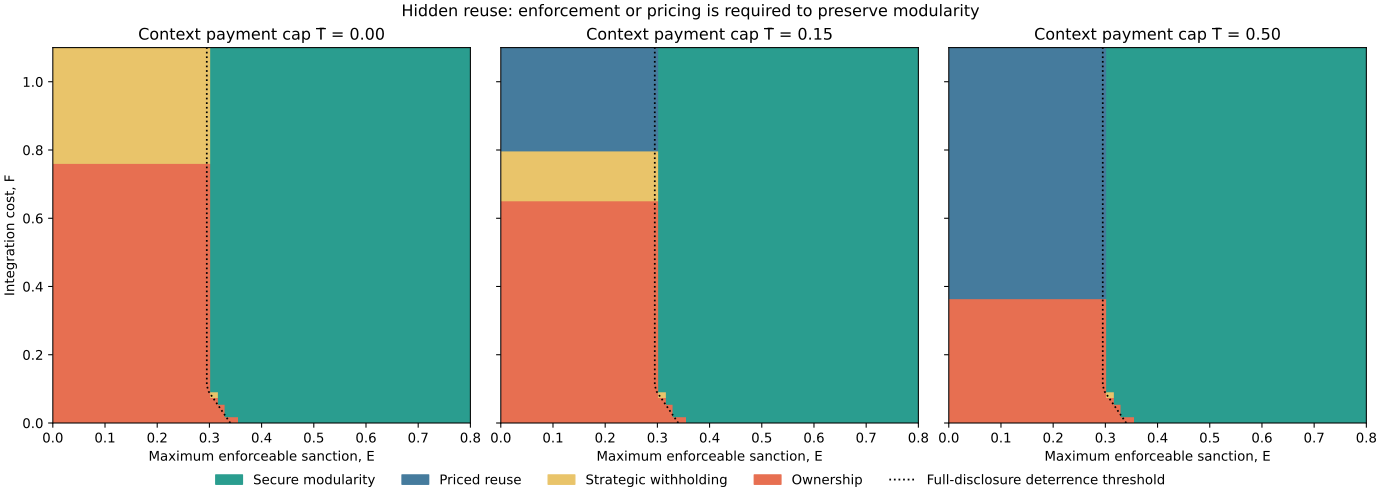
Figure 1. Governance under hidden reuse. The horizontal axis is maximum enforcement capacity and the vertical axis is integration cost. Across the panels, the payment cap $\bar{T}$—the largest payment the provider can credibly make for the learning right, per disclosed unit—rises from zero to 0.15 to 0.50; Figure 2 derives this cap as the pledgeable value $P^*$. The dotted curve marks where full-disclosure deterrence becomes feasible; it is not by itself an equilibrium boundary. Weak enforcement and cheap integration support ownership. Weak enforcement and expensive integration support withholding when learning cannot be priced. Greater payment capacity replaces much of that withholding with priced reuse.
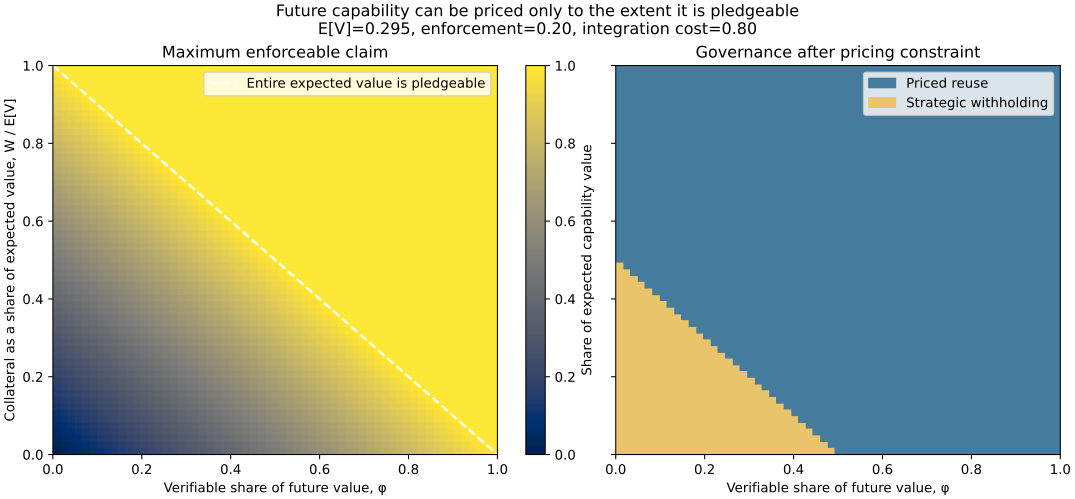
Figure 2. Pricing uncertain capability. The left panel shows how much expected future value is collectible as verifiability and collateral change. The right panel feeds that payment limit into the hidden-reuse game as the cap $\bar{T}=P^*$. Under the displayed weak-enforcement scenario, low pledgeability produces withholding; enough collateral or verifiable value restores full disclosure with priced reuse.
Integration entry and firm size (Result II) Link to heading
Call each clinic, factory, laboratory, or warehouse a context-generating asset, and let $A$ be the per-asset internalization advantage from owning it rather than using its best independent AI contract. Scale requires four additional forces: a shared platform fixed cost $K$; cross-asset learning with maximum strength $L$ and saturation rate $\kappa$; cumulative integration-execution cost with scale $d$ and elasticity $0<\rho<1$, so successive integrations become cheaper; and ongoing coordination cost with scale $c$ and rate $\eta$, which becomes increasingly burdensome as the firm grows. For a firm owning $n$ similar assets,
$$ V(n)=nA-K+nL\frac{n-1}{\kappa+n-1}-dn^\rho-cn^{1+\eta}, $$and when potential owners compete for assets, the relevant value per asset is
$$ g(n)=A-\frac Kn+L\frac{n-1}{\kappa+n-1} -dn^{\rho-1}-cn^\eta. $$The organization can become better at adding assets while still becoming harder to operate once those assets are inside. Because $A$ enters additively at every size, raising it moves the whole curve up without moving its maximum — the separation of Result II. That separation is a characterization, not a free result: if owning more assets dilutes the per-asset advantage (the solver exposes $An^{-\zeta}$), the entry and size margins interact, and a stronger contracting problem can buy entry while shrinking the firm.
In the illustrative calibration, the scale terms make eight assets the best integrated size. Strong enforcement generates an internalization advantage of 0.430, too little for integration; weak enforcement with unpriced reuse raises it to 0.778, so eight-asset firms form. The contracting shock changes entry from no integrated firm to an eight-asset firm; it does not itself select eight. An Arrowian problem can thus create many small integrated operators if learning at one asset is useless at the others—a rollup requires some scalable complementarity beyond the contracting failure itself.
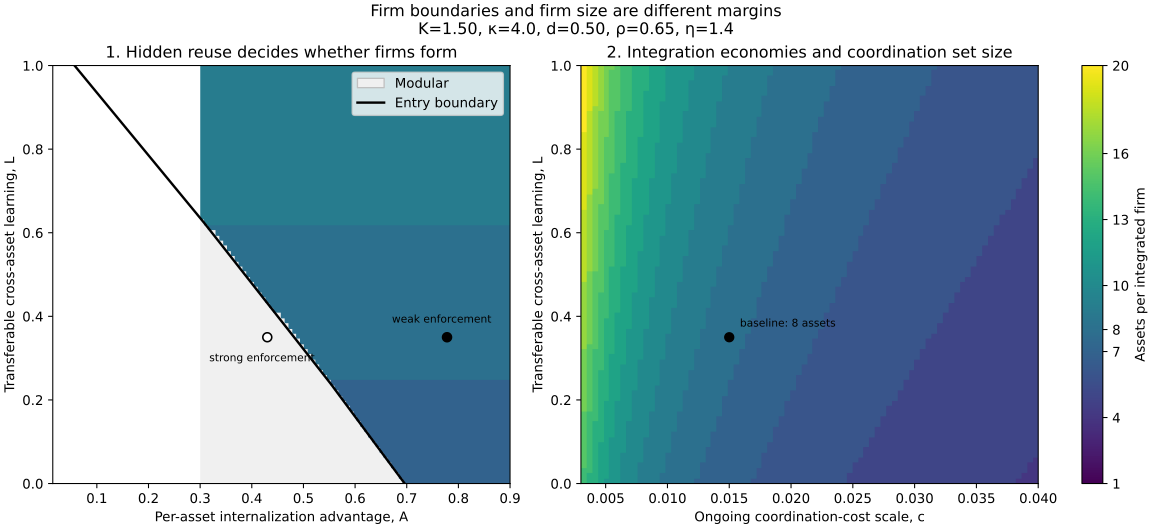
Figure 3. Integration entry and conditional size. The left panel varies the internalization advantage and transferable learning. Moving horizontally can cross the black integration boundary without changing firm size within a row. The right panel isolates scale: stronger cross-asset learning supports larger firms, while greater ongoing coordination cost supports smaller ones.
Learning networks, platforms, and rollups (Result III) Link to heading
Let $q\in[0,1]$ be external learning efficiency: the fraction of useful cross-business learning the intermediary can lawfully, technically, and commercially realize while the businesses remain independent customers. This permissioned learning is different from hidden reuse: hidden reuse lowers the value of an independent contract, while $q$ measures what an independent relationship can legitimately deliver.
Learning is directed—$\gamma_{ij}$, the value of learning generated at operation $i$ when applied at operation $j$, need not equal $\gamma_{ji}$. Suppose one intermediary initially serves every operation and may acquire a set $S$. Relative to remaining a neutral platform, the private value of that acquisition is
$$ \Delta(S)= \sum_{i\in S}a_i +(1-q)\Gamma_I(S) -C(S) -\chi D(\partial S), $$where $a_i$ is the direct internalization advantage of owning operation $i$, $\Gamma_I(S)$ sums directed learning with source and destination inside $S$, $C(S)$ includes ownership and coordination costs, $D(\partial S)$ is the value of customer relationships crossing the new ownership boundary, and $\chi$ measures how much of that value partial ownership puts at risk.
The customer-conflict term is zero for a neutral platform and zero for a full rollup of the closed network; it is largest for partial ownership. Strong customer conflict therefore need not make the firm gradually smaller—it can eliminate intermediate structures altogether, leaving a full rollup when $q$ is low and a neutral platform when $q$ is high.
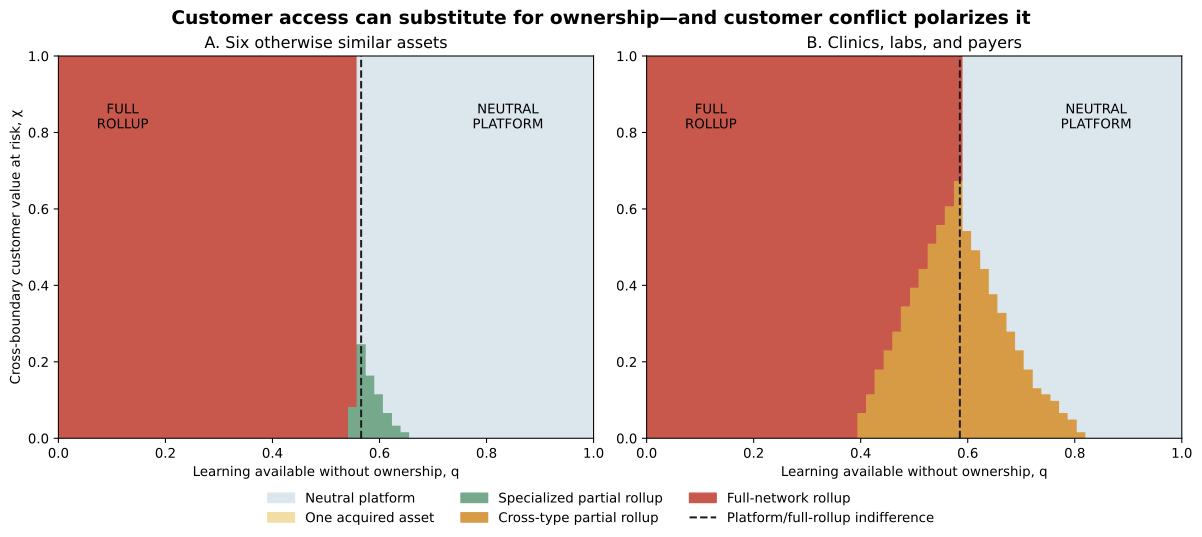
Figure 4. Platform, partial rollup, or full rollup. The horizontal axis is learning available through independent customer relationships; the vertical axis is customer value at risk from partial ownership. At the top, customer conflict removes intermediate structures. At the bottom, partial structures survive. Heterogeneous assets create a wider middle because particular combinations are more valuable than others.
Two specification choices favor this polarization, and the package stress-tests both. The full rollup bears zero conflict only because the model’s network is closed; adding never-acquirable fringe customers taxes the rollup as well, yet the all-or-nothing switch survives. The quadratic internal learning term is convex in firm size and independently favors corners; replacing it with the saturating learning form from the firm-size model overturns the result at the displayed conflict levels—high conflict then compresses partial ownership rather than eliminating it. Polarization is therefore a prediction about markets where cross-asset learning keeps compounding with scale, not a general consequence of customer conflict.
The topology counterexample holds fixed the six businesses, direct ownership values, customer relationships, organization costs, and total directed learning, changing only which operations learn from which others:
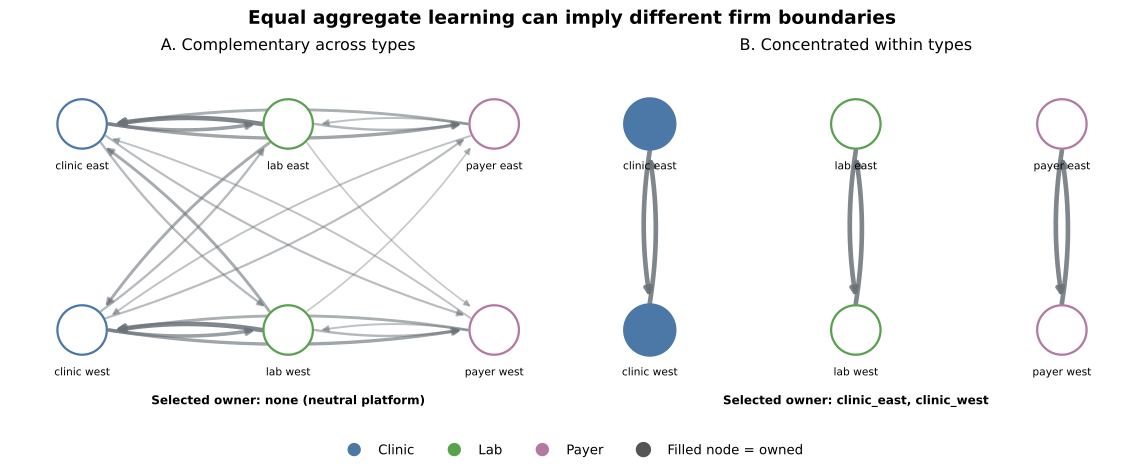
Figure 5. Equal aggregate learning, different firms. When learning is spread across complementary vertical links, independent access is sufficient and the intermediary remains a platform. When the same total learning is concentrated between the two clinics, the intermediary acquires those clinics. Filled nodes are owned.
Value capture (Result IV) Link to heading
An intermediary can solve the learning-access problem and still have a weak business model: its system may create one hundred dollars of operating value at a customer but collect only twenty-five through the service price, because the customer observes its own avoided mistakes and savings more clearly than the provider does. If the intermediary buys an operating business, an improvement no longer needs to be converted into a service invoice—some of it appears in the acquired business’s operating cash flow. Ownership changes the claim on value; it does not make the value free.
Define $p$ as the share of AI-created operating value captured through service prices and $o$ as the share retained at an owned operation after the acquisition price, seller bargaining, financing, liability, and output-price pass-through. Neither share is a free calibration: both are derived from the same pledgeability logic that priced the learning right in Result I, applied to opposite sides of two markets. In the service market the AI firm is the charging party, so $p=\min{1,w_s+\phi_s}$; in the market for corporate control the seller is the charging party, capitalizing only the pledgeable share of prospective gains into the acquisition price. Under symmetric frictions, $o$ exceeds $p$ exactly when the pledgeable share of AI-created value is below one half. The capture case for ownership is therefore a falsifiable claim about relative verifiability across the two markets: if diligence and earn-outs capitalize most expected AI gains, or outcome-contingent service pricing improves, the wedge shrinks or reverses.
To discipline $p$, the package turns the task-value distribution in “A Complexity Theory of AI Value Accrual” into a benchmark in which one provider posts one price. If task values follow a Pareto distribution with tail parameter $\alpha>1$, the provider’s share of net value on served tasks is
$$ p(\alpha)=\frac{\alpha-1}{2\alpha-1}. $$At $\alpha=1.5$, the provider captures 25 percent and customers retain 75 percent—a single-price monopoly benchmark, not a universal prediction.
For a candidate acquisition set $S$, with $B(S)$ the baseline AI-created value at owned operations, the exact private acquisition value becomes
$$ \begin{aligned} \Delta(S)= &\sum_{j\in S}a_j \\ &+(o-p)\left[B(S)+q\bigl(\Gamma_I(S)+\Gamma_X(S)\bigr)\right] \\ &+o(1-q)\Gamma_I(S) \\ &-C(S)-\chi D(\partial S). \end{aligned} $$The second line is the capture upgrade: value that independent customer access could already produce but that ownership lets the intermediary retain more readily. The third line is the productive learning upgrade: learning that common ownership actually makes possible. Differentiating in $q$ yields the complementarity condition of Result IV: customers can be learning sources while owned operations become value-capture destinations.
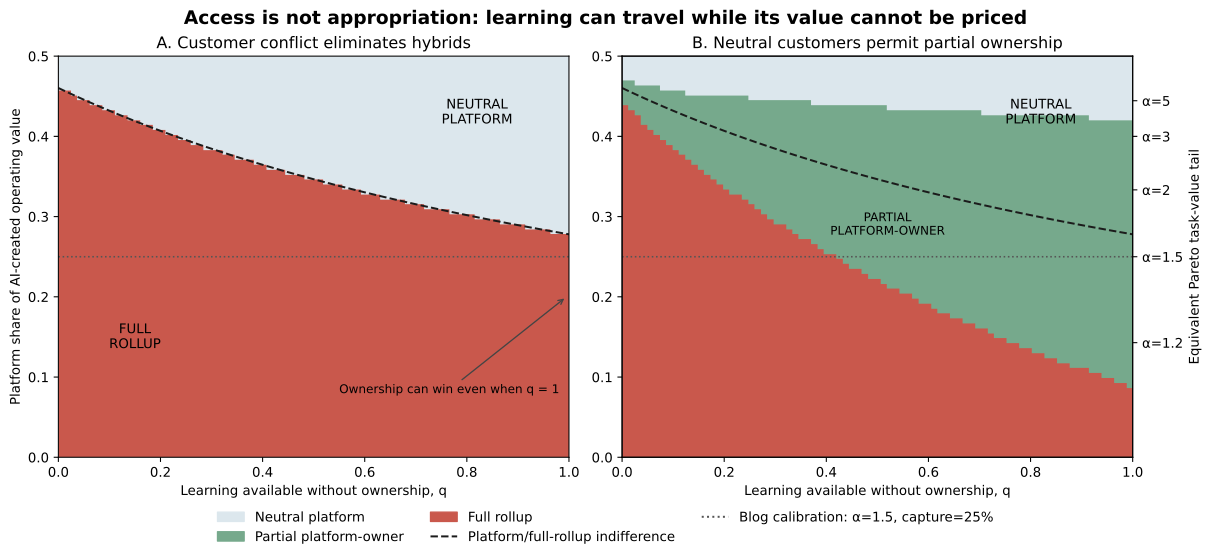
Figure 6. A platform requires learning access and value capture. The horizontal axis is the fraction of cross-business learning available without ownership. The vertical axis is the provider’s capture share through prices. With high customer conflict in the left panel, partial ownership disappears, and the full-rollup region reaches the right edge: ownership can win even when customer relationships transmit all useful learning. With low conflict in the right panel, partial platform-owner hybrids occupy the middle. The dotted line marks the 25-percent Pareto pricing benchmark.
Computation and reproducibility Link to heading
The package does not ask language-model agents to improvise strategies, and it does not estimate the parameters from market data. It solves each stated model directly:
| Computation | What is solved |
|---|---|
| Hidden reuse | For each disclosure level, second-period payoffs, the incentive to reuse, monitoring required for compliance, feasible transfers, and the preferred contract or ownership alternative |
| Capability pricing | Maximum collectible payment from expected value, verifiability, and collateral; plus a two-type posted-price comparison |
| Homogeneous firm size | Total and per-asset surplus at every feasible integer size, integration entry, and the maximizing size conditional on entry |
| Ownership access | Private value of every acquisition subset for one intermediary; with six nodes, all $2^6=64$ sets are checked |
| Value appropriation | Every acquisition subset with capture and productive-learning gains recorded separately, plus the Pareto pricing benchmark |
The phase maps repeat these solutions over transparent parameter grids. The ownership-access and value-appropriation exercises also perturb the stated calibrations with fixed random seeds and resolve every candidate organization. In 600 nearby synthetic networks, the ownership-access model’s full-rollup, partial-rollup, and platform anchors retained their broad organizational forms in 98.8, 97.3, and 100 percent of draws; in the value-capture extension, the learning-rollup, full-access capture-rollup, neutral-platform, and partial-owner anchors did so in 65.5, 67.5, 98.2, and 83.7 percent. The lower frequencies for the two capture-rollup anchors correctly reveal that they lie nearer a regime boundary. These are synthetic sensitivity checks, not estimated probabilities of real market structures.
The authoritative artifacts are the static SVG figures and solved grids. The
research package is public at
github.com/sorenlarson/market-for-context.
The self-contained publication package is the
hidden-reuse-result/
directory; the surrounding repository preserves earlier exploratory models for
provenance. To regenerate and audit every result:
git clone https://github.com/sorenlarson/market-for-context
cd market-for-context/hidden-reuse-result
make audit
For readers who want proofs or implementation details, the package contains the four result notes, model definitions, source modules, solved grids, figure metadata, and reproduction instructions.