Last week Google beat out Mercor in acquiring a complete operational dataset from Spirit Airlines, reportedly including internal document, email, workflow and codebase for $10mm. Mercor reportedly bid $7.5mm. This comes after Google’s rumored acquisition of leading RL-env developer Mechanize.
It appears that the labs are realizing vertically integrating over their data supply chains is the dominant strategy
i think it makes sense for frontier labs to verticalize over their data; so long as they pay mercor and handshake, they both capitalize their competitors and depreciate the value of their own models
wrote @fleetingbits. If you believe candidate datasets contain alpha, why would you let Mercor et al. turn it into beta, distributing it to you and all your competitors.
And to vertically integrate over these data flows, you may well need to explore unusual acquisition paradigms, as data you want may not be available but for the special circumstances e.g., of Spirit Airlines. Will Manidis explored
it seems likely that the frontier labs begin to look like chaebols/diversified conglomerates as the only practical way to hill climb long duration / not immediately verifiable tasks is to own the operating companies yourself and run them as firm-scale-rl-envs
As I’ve previously written (e.g., here or here), I’m strongly bearish the long term value of data intermediaries. If labs buy data for the development of unique capabilities that make customers switch to using their intelligence, why would a lab wish to support a company whose mission it is to democratize alpha within these datasets? They obviously wouldn’t.
A brief history of alternative data Link to heading
This follows the market structure of the alternative data market, though with one important difference.
Alternative data –– the sale of satellite, credit card, app location –– came to prominence in the early to mid 2010s, though dates back to Majestic Research in 2003. The industry most famously served hedge funds who used the data to ’trade the quarter’: using data collected ahead of earnings to predict company performance before it was announced.
I helped launch Consumer Edge’s credit card transaction product, working on data sourcing, privacy, product and GTM.
But the industry contracted quickly. Consistent with economic theory –– an inverted form of the Nobel-winning Market for Lemons –– the industry disappeared from below. In information markets, and contrary to the usual form of the Market for Lemons, buyers are better informed than sellers, meaning the market disappears from below, leaving only holders of truly scarce information.
Alternative data is also different in the way that it’s exercised. In hedge funds, alternative data is used adversarially: when you engage the market there’s someone on the other side. It’s valuable to know what your competitors know. The market then needs to buy data even if it’s beta.
AI inference doesn’t appear to have this property. If Gemini is particularly good at a given workflow, you might like to improve Gemini similarly to keep people on your API, but it isn’t existential like it is in markets. In this way, alternative data for finance has an existential reason to exist: the market needs to know what everyone else knows. That’s not true for AI.
As I’ve repeatedly referenced, borrowing Alex Danco
capitalism is the delivery of shareholder value by the abundant delivery of scarcity
as intelligence becomes too cheap to meter, we identify remaining sources of scarcity, which to me appear to be
- human attention
- trust, and
- context.
So if context is one of the Final Scarcities, yet information markets have an intrinsic adverse selection flaw that induces consolidation, we have clues about the future market structure generally.
The former Conglomerate Discount Link to heading
Conglomerates were popular in the US for decades but now only a few remain. There is much writing on conglomerates (e.g., those in Asia thanks to @jai_kondapalli for the links!!) but I’m most interested in them in the U.S.
A piece from HBR summarizes it well: in the US the typical discount ranges from 6% to 12%. There’s a general view in the US that focused enterprises are better at creating shareholder value than diversified ones, and that investors are better left to perform diversification than operators.
Michael Goold, Andrew Campbell, and Marcus Alexander of the Ashridge Strategic Management Centre summed the reason up when they asked: “Why should the parent’s managers, in 10% of their time, be able to improve on the decisions being made by competent managers who are giving 100% of their efforts to the business?”
Conglomerates have been noted to suffer from operator empire building and a distracted management class. It is true that conglomerates also tend to be more difficult to value –– with overlapping business lines and accounting that can make it difficult to understand the true revenues of a business.
That said, these operational challenges appear real. Of course, AI hasn’t the bandwidth issues that a traditional manager has. AI may well relax prior operational challenges while creating new issues that make a conglomerate existential.
A meta learning loop Link to heading
Two months ago Microsoft’s Satya Nadella published his piece on X: A frontier without an ecosystem is not stable. He explored the future of the firm in the age of AI
This means the real opportunity is not in picking the best model but instead in building a learning loop on top of models where human capital and token capital compound. You can offload a task, or even a job, but you can never offload your learning. The future of the firm is the ability to compound that learning across people and AI.
He goes on
This loop becomes the new IP of the firm. I think of it as a hill climbing machine. And unlike most assets, it compounds. Every improved workflow generates better training signal, which accelerates the accumulation of tacit knowledge unique to the firm. The companies that build this early will have an advantage that is hard to replicate, regardless of any new individual model capability.
Everyone in the industry jumped on this to exclaim this supported Their Thing. Of particular note was Applied Compute building Specific Intelligence, who Satya spoke with later in the month. Satya remarked
“My simple thing is there should be as many models in the world as firms in the world. Because after all, what is a firm? A firm is a learning system.”
These are interesting notes just as firms are beginning to sell their operational data.
If private operational data and its compounding learning loops were the future of the firm, what are people doing selling it? And what value is there in buying it?
It rather seems obvious that if the learning loop from one firm were valuable, probably more valuable is the learning loop running on two firms’ –– five firms’! ten firms’! fifty firms’! –– data.
If you accept Satya, and also understand from
- Akerlof
- Kenneth Arrow, and
- MIT’s Alessandro Bonatti that information markets are no darned good and experience market failure, you might reasonably start to wonder whether conglomerates were so bad to begin with; whether AI resolves their original sins.
AI collapses internal coordination costs Link to heading
If a business’ operations are entirely legible to AI, it seems natural that AI should be able to operate much of a business. Decisions that used to require people to structure, study and manage could be increasingly handed to AI, as decision making becomes more and more data driven.
The problem of conglomerate management only having a little bit of time to manage each sub-business shrinks because now AI is managing so much of it. The bureaucratic overhead that might have made external transaction costs of Coase high now fades.
AI makes external coordination expensive Link to heading
As I’ve previously written, and Kenneth Arrow famously wrote and now implies, AI makes external transaction costs high.
This is contrary to the Coasean Singularity bulls, most notably recently Anthropic’s head of economics Peter McCrory
Increasingly people are relying on AI systems to take actions on their behalf. If that produces a collapse in transaction costs and so on that might reshape how systems of economic exchange are organized.
I continue to find observations of AI eviscerating external transaction costs to be –– at best –– poorly considered. It’s clearly true that AI can reduce coordination costs within the firm, but the effect externally requires consideration of second-order competitive effects it seems most have not thought through (or are financially motivated to ignore).
I enumerate these in my March 2026 blog Against the Coasean Singularity, which I later realized was somewhat of a rehashing of Kenneth Arrow’s well-cited paper that information markets have no transaction structure that allows for the monetized exchange of information without giving it away. When firms’ agents transact on their behalf, showing interest in transacting leaks information about firm activity and what they find valuable.
AI increasing the value of scarce context means that transacting over it –– openly representing the shape of any private economic activity to the market – is expensive. It’s true that most enterprise contracts prohibit the usage of customer context for improvement of a platform, but those terms are difficult to practically enforce. The law firm Cooley –– with explicit agreements about the sensitivity of client engagements –– broadly markets its technology market access and accumulated insight as one of its core value propositions.
Grossman and Hart’s famous 1986 paper on The Costs and Benefits of Ownership cover exactly this issue. When you can’t effectively contract controls over assets –– here context requisite for the provision of a service by a third party –– it’s optimal for a firm to vertically integrate.
The Coasean Singularity bulls have so far provided no response to this, continuing to vaguely gesture at “lower transaction costs”. My guess is that none of these bulls have sat close to financial markets and as such have little experience with competitive stakes. For this apparently you need paranoid New Yorkers not blue sky Californians.
Taking now as given that AI reduces internal coordination costs while increasing external transaction costs, this makes way for AI’s new motivation for conglomeration.
AI as new motivation for conglomeration Link to heading
Taking what we’ve supposed together:
- AI reduces internal coordination costs
- AI increases external transaction costs
- quality of learning loops is nondecreasing in aggregated operating companies the conglomerate discount flips to a Conglomerate Premium. The forces that punished diversification now reward it.
There’s much theory about what makes for a good conglomerate –– under what conditions would you consider acquiring a marginal company? For this blog I follow HBR’s 1987 “From Competitive Advantage to Corporate Strategy”. It sets forth three criteria for absorbing a candidate business
- The Attractiveness Test
- The Cost of Entry Test
- The Better Off Test
In the Attractiveness Test, you’d wish for the target industry to be structurally attractive i.e., possesses some real scarcity. AI’s ‘software singularity’, as Peter McCrory puts it, may make some industries less attractive. But the governing idea is that industries with intense competition, commoditized products, or asymmetric market power without compensating entry wedges will be unfriendly.
In the Cost of Entry Test, it must be that the cost of entry doesn’t eat all future profits. If you have to pay a full-value acquisition price for an attractive business, the seller ends up with all the surplus. The HBR article finds empirically that most corporate diversification attempts failed this test.
On the other hand, as I posed in Cybernetic Arbitrage, the whole point of building a Cybernetic Rollup is to generate a compounding information advantage from company acquisition –– either from sticky customer relationships or systematized learnings from high entropy operational contexts –– that allows you to engage markets others can’t or can’t correctly price given your operational or distribution-based advantages. In this way, for the Cybernetic Rollup the cost of entry should go down.
Finally, previously most acquisitions failed the Better Off test as corporate centers couldn’t deliver enough cross-unit value––“Synergies”––to justify overhead. But now, with context as a newly liquid and scarce asset, corporate centers can activate shared context across all its units: customer intelligence from one conglomerate portco informing product development in another; operational patterns in one informing improving pricing in another; all led by AI.
Conglomeration unlocks new value propositions Link to heading
Sometimes new value propositions require not product innovations but changing the boundaries of a firm.
@packym has explored this extensively in his Vertical Integrators series
“For Vertical Integrators, the integration is the innovation.”
Consider Base Power. Base Power is an example of a supply chain buffer. Supply chain buffers –– elements in supply chain that can absorb extra supply to protect against exogenous shocks –– particularly those at the edge, are interesting because they can offer a superior value proposition as a wedge to disrupt incumbents.
In Base Power’s case, it keeps homes powered even under outages at a lower price. If it were merely a battery without corresponding market infrastructure, as Packy notes, it might not be able to arbitrage energy prices and offer lower prices. The innovation of conglomeration vertically is the innovation, and it is specifically the thing that allows Base to offer this new value proposition v letting such surplus be stranded or be absorbed by incumbents. Other supply chains pose similar opportunities where discussed dysfunction of information markets would block surplus from directly flowing to end-users for a shy vertical integrator v enriching incumbents.
Who accrues the Conglomerate Premium? Link to heading
Clearly MBAs buying companies for Synergies is not the answer.
So who is poised to generate the Conglomerate Premium v those who won’t? Taking strong execution as a constant, I think it breaks down by who best exploits learning loops while conserving scarcity and distribution v those who do not.
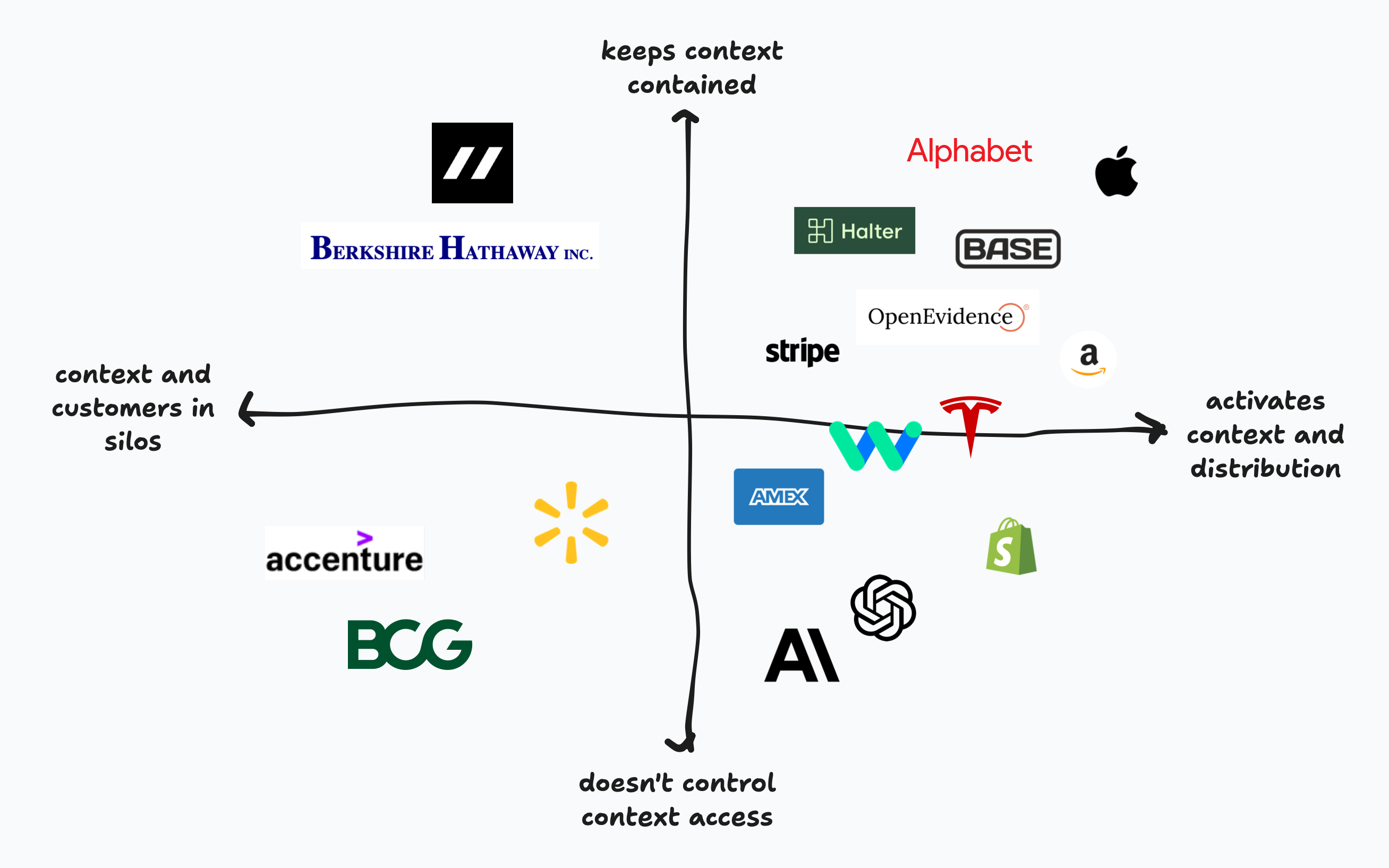
Apple does everything in its closed ecosystem. It capitalizes its distribution to sell digital services and ads while keeping everything private within its ecosystem. Same is true for Base Power, Halter, and Open Evidence. Stripe, with its acquisitions of OpenRouter, Metronome, and Privy is poised to develop a Conglomerate Premium for its activation of developer distribution or ownership of core internet primitives. The most exciting examples––like Base Power––use verticalizing conglomeration to offer new customer value propositions. Apple is synonymous with trust, a scarce resource that serves as an umbrella over all its offered products.
OpenAI and Anthropic expose context as a part of their inference business. They are not conserving scarcity. Shopify exposes merchant inventories in products.json though it also develops Shopify Audiences to create an exclusive economizing ad product on the basis of opted-in Shopify merchants.
Berkshire Hathaway portcos may well keep context contained, but it does not interfere with operations and does not combine context across its portcos. Rumor is Thrive Holdings operates in a similar way.
Finally, companies like BCG and Accenture––and Walmart to a lesser extent––effectively keep context in silos (BCG partner-led Offerings do not share resources) but, as a part of doing business, share all context developed for an engagement. Partners own the customer relationship––cross selling is expensive and perhaps even face countervailing incentives among partners. It’s true Walmart runs a retail media business that monetizes its shopper context but it hasn’t the broad product portfolio activating its distribution as Amazon.
In short, the Conglomerate Premium accrues to diversified firms that activate cross-vertical context and distribution; and protect the context from leaking through market transactions.
If you can develop accumulating advantage through aggregation and AI, how does a singular business––with more expensive distribution, higher-variance decision making, depreciating context access, or worse/fragmented value proposition––compete?
They can’t. The Conglomerate Premium is a markets-forward Hayekian-friendly vision of centralization.