Clay Christensen has two theories of disruption.
The one everyone knows – new technology comes out that
- incumbents ignore or don’t understand
- is misaligned with existing business
- doesn’t directly serve existing customers but unlocks new markets that end up dominating. This is the classic Blockbuster v Netflix story. It may very well also be a story of the labs v the responsibility-bearing application layer.
But Christensen has a second theory of disruption – that of “Low-End Disruptors.” It identifies weakness in any rise of vertical integrators. It famously led him to doubt Apple’s iPhone––“the iPhone is a sustaining technology” he once wrote. In 2013, Ben Thompson disputed Christensen’s theory, providing consumer-led motivation for Apple’s vertical integration.
For a while, it’s seemed Ben is right. But the AI-era is changing things.
This would be concerning, as vertical integration appears one of the best paths to durable business.
In this new era, are there properties of businesses that make vertical integration naturally occurring v something that could be tossed by Christensen’s Low-End disruptors?
Can Superpower vertically integrate? Link to heading
To address the question, I start with a case-study: Superpower.
Superpower seems like it should be able to be vertically integrated. But something feels off.
For the uninitiated, Superpower is a digital health platform that provides blood test diagnostics, supplements and RX personalized to your health markers.
The brand is pristine and it’s backed by smart investors – Long Journey, Susa, Forerunner. This really seems like something that should work –– a unified user experience for all things health. They just launched peptides.
I don’t have any inside information, but I’m getting the sense that vertical integration here won’t be as natural as might have been imagined in prior eras.
Last year Superpower shipped an AI-powered app to help people understand their blood tests. The X timeline didn’t receive it well.
Reflecting on it, their vertical integration feels a bit awkward.
Why would I lock health data from a single blood test in a single company? Will its associated supplements and peptides be well priced or even the ones I want? Today I can add my blood tests to Claude –– Nat Friedman is! Further, with services like Private MD Labs (I have no relation to them other than being a customer) I can order low-cost blood tests directly, choosing exactly the tests I want.
PrivateMD pricing felt easier to understand, and I can order as many tests throughout the year as I want.
So what’s going on here?
To find out I revisit the sacred texts of vertical integration.
What Clayton Christensen Got Wrong Link to heading
We get Clay’s take on vertical integration by way of his theory of disruption.
During the early stages of an industry, when the functionality and reliability of a product isn’t yet adequate to meet customer’s needs, a proprietary solution is almost always the right solution — because it allows you to knit all the pieces together in an optimized way.
But once the technology matures and becomes good enough, industry standards emerge. That leads to the standardization of interfaces, which lets companies specialize on pieces of the overall system, and the product becomes modular. At that point, the competitive advantage of the early leader dissipates, and the ability to make money migrates to whoever controls the performance-defining subsystem.
Clay claimed in a 2006 interview. Ben synthesizes
Briefly, an integrated approach wins at the beginning of a new market, because it produces a superior product that customers are willing to pay for. However, as a product category matures, even modular products become “good enough” – customers may know that the integrated product has superior features or specs, but they aren’t willing to pay more, and thus the low-priced providers, who build a product from parts with prices ground down by competition, come to own the market. Christensen was sure this would happen with the iPod, and he – and his many adherents – are sure it will happen to the iPhone.
This is the second theory of disruption: The Low-End Theory of Disruption.
Perhaps what’s happening to Superpower is literally what Christensen describes: we’re no longer in the early stages of diagnostics. Diagnostic tests themselves are a commodity. The specialization needed to interpret results is broadly available via AI consumers can access for free. Perhaps the performance-defining subsystem is just the diagnostic itself––and PrivateMD––Quest/Labcorp thin wrapper––is the closest thing to the performance-defining substrate?
Ben thought this take was flawed, though, because consumer products are never actually “good enough.”
Modularization incurs costs in the design and experience of using products that cannot be overcome, yet cannot be measured.
He even generally claims
Modular providers can not become “good enough” on all the attributes that matter to the buyers
But what really was the cost of modularization that I incurred here with PrivateMD Labs and Claude? I got a sort of inscrutable PDF from Quest and ctrl-c, ctrl-v’d it into Claude. Claude handles the time series of test results fine.
The Baseline plan on Superpower provides a single annual test. I’m going to lock in data from a single test to get upsold products when I could do everything as I like myself?
In this case, contrary to Ben, it feels like giving up modularization is costly!!
I should say here I have nothing against Superpower––I just think it’s an interesting case study for the candidacy of vertical integration (“bundling”) in this new era. Clearly AI makes integration across different interfaces (e.g., PDF to an intelligible response) natural and inexpensive.
Does this mean everything can be modularized now?
High frequency and low latency sensor/actuators are different Link to heading
If there were a lot more data, or if the data were sensed more often, perhaps Superpower’s integrated approach would reign v my modularized one?
Suppose I were getting blood tests every month. Rhythm Health offers this for $79 / month. Perhaps managing all the reports in a Claude Project would be a bit more annoying. Higher frequency sensing seems to motivate integration, even as AI makes it more seamless for systems to integrate.
Apple Watch and Oura Ring align with this intuition –– why would I want a modularized approach for a stream of sensor readings? I’d rather just look at my Apple Watch. Anthropic shipped an integration with Apple Health, but it can’t see all my data and doesn’t provide much that Apple Health does not. Integration appears to reign.
Autonomous applications take this idea to the limit. Indeed, the self-driving market has followed Christensen’s writing exactly: Waymo launched with a practically vertically integrated solution, while now Wayve––a later entrant––is producing a modularized one, an autonomy solution that works on any car.
But vehicle autonomy reveals something different than Oura or Apple Watch. While Oura and Apple Watch do face competitors, they’re not modularized in the same way Waymo might be by Wayve.
Complex interfaces afford vertical integration Link to heading
Waymo is obviously doing just fine, but it’d be nice if its industry-leading technology investment conferred it market power.
That’s not how it’s playing out. Competitors like Wayve are modularizing the autonomy stack, unlocking autonomy in any car, not just those operated by Alphabet.
What makes this case different from Apple Watch or Oura?
Although Waymo is a complicated piece of technology, its user-facing surface––its “interface”––is not. It’s wild to think about: Alphabet has reduced incredible complexity
- a car
- with sensors
- on-device intelligence
- integrated connectivity
- insurance etc., into a single action:
Where to, Soren?
Assuming other autonomy makers have similar reliability, safety etc., it’s hard to see why Waymo’s well-motivated vertical integration defends attack from modularized approaches.
This shows that Ben Thompson’s
Modular providers can not become “good enough” on all the attributes that matter to the buyers
is wrong. Modular providers can and are becoming “good enough” but in applications where the user-facing surface compresses to a simple outcome (“take me to MIA”), or the surface doesn’t accrue valuable compounding context.
Oura, Apple Watch, and iPhone have complex interfaces. They attend to sleep, email, music, messages, activity and more. They mediate many interactions across the day and compound across many sensor readings. Waymo, though, does not.
These examples suggest a richer motivation for durable vertical integration that resists AI-powered modularization.
Owning the cybernetic loop is not enough Link to heading
Initially you might imagine that ownership of certain elements of a compounding feedback loop might guarantee protection from Low-End Disruptors.
I’ve previously argued durability flows from owning sensors at the edge that uniquely mine context. It’s worth pressure testing this claim and understanding if or where durable advantage comes from.
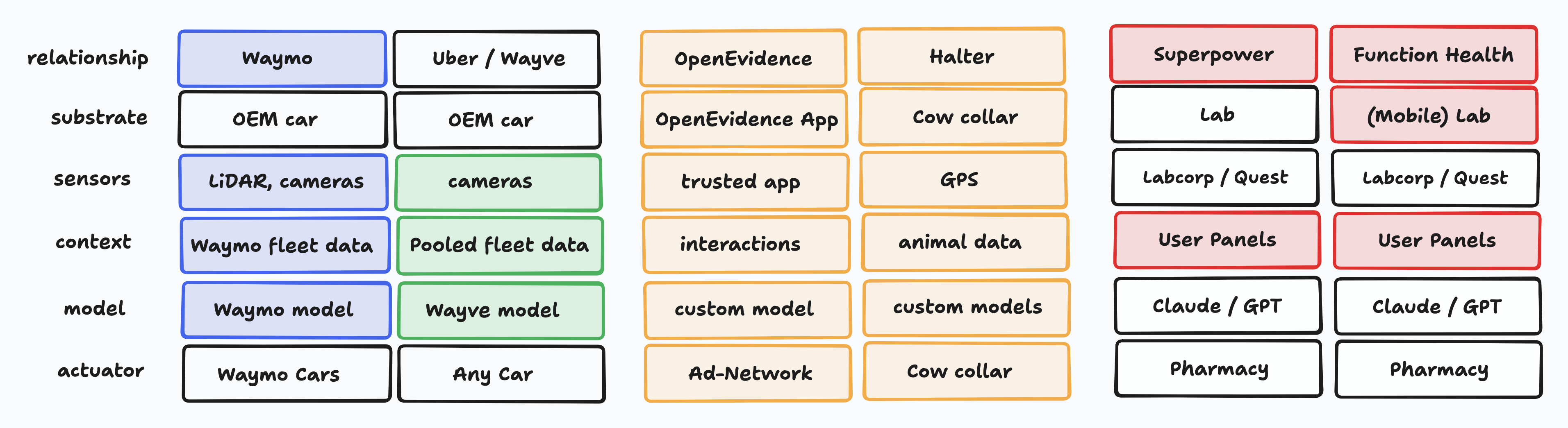
You might suppose a would-be vertical integrator is composed of six components:
- The Customer Relationship. Who owns the relationship with the customer, which can furnish access to context.
- Substrate. The vehicle that deploys sensors. Sensors need to be deployed in the world, and sometimes the thing the sensor rides might be produced by someone else. To be clear, this needn’t mean ownership or direct production of the substrate itself, just control of it to the extent it confers rights to the data from the deployed sensor. From a market power perspective, it’s likely best that this substrate begins first as owned by the integrator, and then contracted once proven as a worthy substrate.
- Sensors. The substrate-deployed sensors that furnish context to the application.
- Context. The context generated by the sensors, as furnished by the substrate and customer relationship.
- Model. The intelligence that operates the generated context. Differentiation at this layer comes from training or operating signals no competitor can access. This advantage near uniformly derives from proprietary sensors or context.
- Actuator. How the intelligence takes action using the context. Actuators matter because they see the context applied by intelligence, and can use their positioning to rent-seek against an application without complete integration. This is one reason why Waymo is an owner-operator: a fleet operator with access to or control of Waymo data could extract rent from Waymo’s intelligence or eventually compete with it. I’m curious what Wayve x Uber data sharing agreements look like.
Starting with Waymo and Wayve, when Waymo launched it had a monopoly on the class of driving data sufficient for autonomous applications. Waymo has integrated
- the Waymo brand
- sensors
- aggregated fleet data
- intelligence to the ends of providing a unified user experience.
On the other hand, the context gleaned through the operation of Waymo is not distinct –– it’s just driving data anyone can collect. The information of a user choosing to go from A to B also isn’t that information rich relative to Alphabet’s other context gathering methods. In this way, Waymo’s data is pretty shallow – it’s not distinct in class nor is its collected user data particularly deep.
So as Wayve, the Low-End Disruptor entered the market, Waymo lost its power over the class of vehicle data to a weaker position of owning the embodied instances of vehicle data at the times and places where its vehicles are deployed. No other autonomous vehicle has the context of a given Waymo at the exact place a Waymo is positioned at a certain time. So the context advantage then emerges from Waymo distribution: does Waymo occupy more time and space than Wayve-powered competitors?
You can contrast this with cases of OpenEvidence and Halter––both fully vertically integrated, owning all elements of this autonomy stack. In the OpenEvidence case, as clarified at The Diff, the context developed is uniquely constituted by the relationship OpenEvidence has with its users. The context only exists because OpenEvidence users trust OpenEvidence, and not some other brand. Halter’s context access is weaker. Halter’s context comes from instance-uniqueness at the edge––every collar is generating signal from one specific cow at one specific moment––rather than from the relational trust that secures OpenEvidence as an asset as a whole.
In this framing, Superpower is now clearly worse positioned. It doesn’t own its sensors, nor do the sensors it contracts constitute a proprietary source of signal. Function Health acquired GetLabs, but it itself is a wrapper on LabCorp and Quest, so it too has no distinct access to signal.
I’d hoped these stacks––following Ben Thompson’s AI integration and modularization piece from last month––could show that ownership of all components of the cybernetic loop confer defensibility.
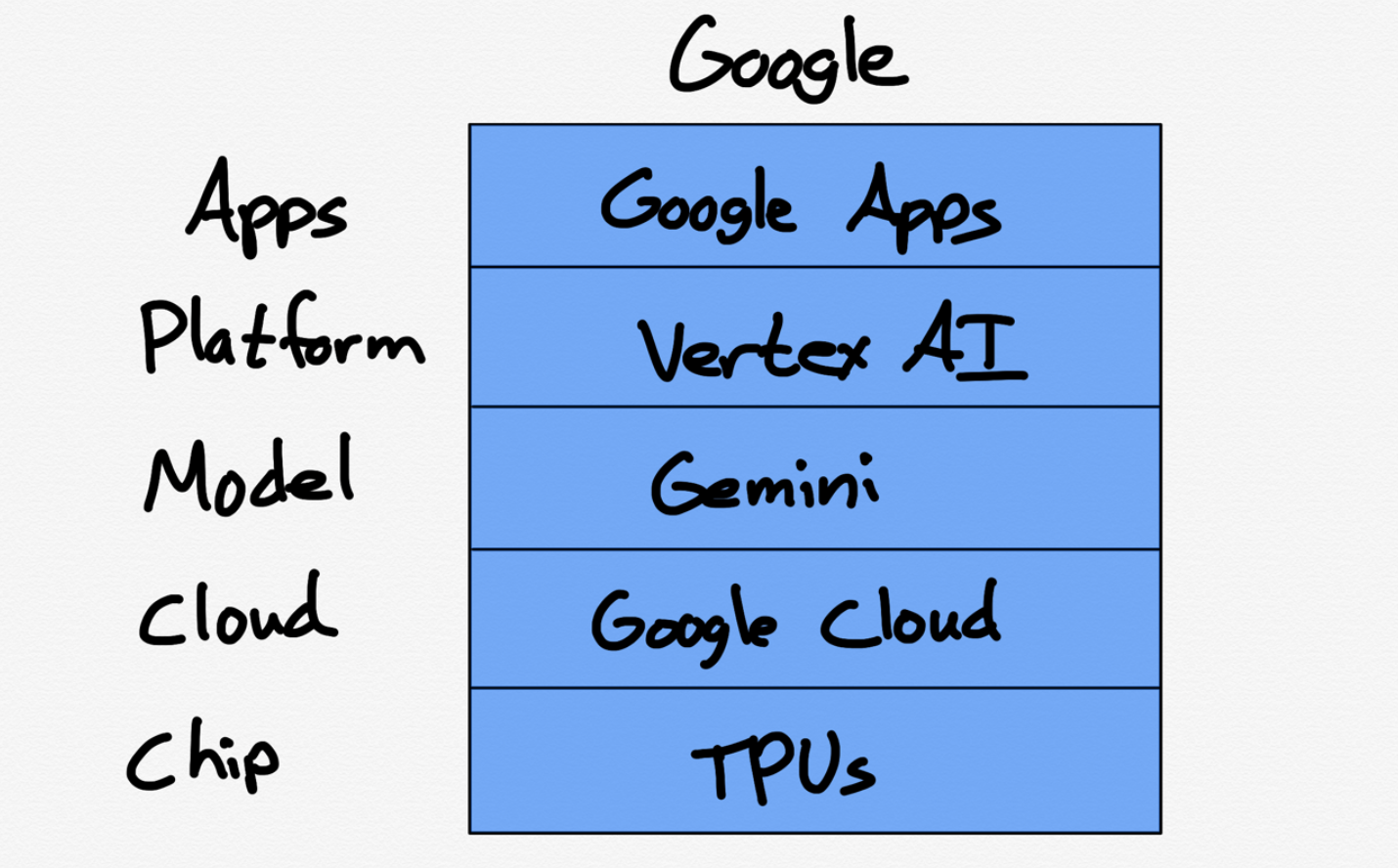
But it seems the app layer is different than infrastructure. Its value is downstream of the differentiated context its trust and attention constitute and market conditions that allow it to keep tight control over context as it flows across the stack.
Ownership of the stack alone clearly doesn’t guarantee defensibility from Low-End Disruptors.
For that we need other criteria.
Defenses against Low-End Disruptors Link to heading
It seems there are six conditions governing whether vertical integration––your cybernetic loop––is durable when a Low-End Disruptor shows up.
At the very least, a candidate vertical integrator should own
- substrate
- sensors
- context but as we’ve seen, the more the better.
Not owning the substrate or sensors can leave you at risk of getting shut out (e.g., B2B AI app layer, data providers v labs) or exposed to counterparties who’d like to use your hard-won distribution to listen to and optimize against your context (e.g., possibly Wayve v Uber).
Here are the six.
Proprietary Signal. The sensor should produce unique signal competitors can’t reproduce. Uniqueness comes from two places: (i) uniqueness in class and (ii) uniqueness in-instance. Uniqueness in class is better. Ideally you’re the only one with this type of signal. Trust-constituted sensors (OpenEvidence) are likely the best example of this. The data only exist because of the trusted relationship with users, and it’s that fuzzy trust that’s difficult to replicate. In-instance uniqueness is what Waymo has now –– other autonomous vehicles companies have similar classes of data sufficient for autonomy, so Waymo’s context advantage reduces to distribution of its vehicles––what penetration of substrate/sensor/context instances does Waymo own v modularized approaches?
Fast loop. Ideally you want latency in sensing-to-action to be zero. If it is, there’s less opportunity for a (consumer!) Low-End Disruptor to toss your aspiring integration. Superpower or Function Health’s panel happen at most once or twice a year, too long a time affording consumers opportunity to modularize and disrupt signal capture with cheap AI.
Dense signal. Signal uniqueness in-instance can compound into value via sensor distribution only if the signal captured is itself dense. If only a little bit of signal is accumulated, there’s less of an opportunity to build a compounding advantage that benefits vertical integration. While Waymo has rich driving data, the user data it collects is shallow. Waymo’s user experience doesn’t get noticeably better the more I use it, but that’s not true with Oura or Apple watch.
Non-compressed user experience. A user experience resists modularization when value is created across many recurring interactions and compounds through context, habit, and trust. If an interface collapses to delivery of a simple outcome from a few interactions, modular providers have a much easier path to becoming “good enough.” iPhone mediates many interactions of many types. So does Oura. But Waymo gets you from A to B. Ben Thompson’s 2013 claim that modular experiences can never be good enough is clearly violated by Wayve.
Category gravity. The larger, more standardized, and more economically attractive a category is, the more it pulls modularized approaches into existence. Low-gravity categories often do not generate enough ecosystem pressure to dislodge an integrated player. Halter benefits here.
Owned actuator. Ideally a cybernetic loop owns and operates its actuator. Sometimes it can’t. Retail is an example and could have been true for Waymo. That is, after Waymo demonstrated its unique technology, it became positioned to set terms with a market of many candidate OEMs. A monopoly in OEMs could have challenged Waymo’s approach. In a case where you can’t own your actuator, the actuator may see information corresponding to the commerce your sensors generate, providing the actuator-owner free market visibility to plan their own low-end disruption. Wayve’s attack on Waymo could well be followed by Uber’s attack on Wayve.
Applying these criteria to top companies we see:
| Distinct Signal | Fast Loop | Dense Signal | Non-compressed UX | Low gravity | Owned Actuator | Score | |
|---|---|---|---|---|---|---|---|
| Halter | x | x | x | x | x | x | 6/6 |
| Waymo | x | x | x | — | — | x | 4/6 |
| Open Evidence | x | x | x | x | — | x | 5/6 |
| AI Fridge | x | x | x | x | — | — | 4/6 |
| Wayve | x | x | x | — | — | — | 3/6 |
| Function | — | — | — | — | — | — | 0/6 |
| Superpower | — | — | — | — | — | — | 0/6 |
Halter is the best protected. Superpower is the least.
These criteria shift over time Link to heading
Unfortunately these criteria aren’t fixed but shift over time. Proprietary signal, fast loops, dense signal, and non-compressed UX are integration pressures, while high gravity and loss of owned actuators pull toward modularization. Where a category settles depends on which forces are winning. AI has both strengthened the value of distinct signal and fast loops, as well as the impacts of high market gravity and no actuator ownership.
For instance, in 2018 Waymo likely satisfied all 6 criteria. No modular solution to custom LiDAR existed, so UX compression wasn’t an issue. Category gravity hadn’t really started and integration was an engineering necessity v a strategic choice. But the market shifted, exactly as Christensen predicted.
A clear lesson here is that Ben Thompson’s grand claim
Modular providers can not become “good enough” on all the attributes that matter to the buyers
is obviously wrong. AI is allowing modularized players to legitimately be “good enough” and maybe even “better.” But a modularizer has its own challenges, particularly in owning and controlling context, a key component of this era’s new scarcity.
So with context, trust, and human attention scarce, I still strongly believe vertical (and horizontal) integration is the best available strategy, particularly if you show these conditions hold.
AI has heightened competition, which makes conviction, capital, and speed more important, particularly when fast loops, dense signals, and expensive/non-compressible coordination are up for grabs.
Revisiting Superpower, it’s hard to see how more brand, capital, or peptide launches can change the fate of this wannabe vertical integrator.
The bet any aspiring vertical integrator must make is that these conditions will hold long enough to capture the market before a Low-End Disruptor arrives to put them to the test.